
How to catch up on a dental insurance posting backlog: a seven-step plan
Stop the backlog growing, size it, gather the remittances, post oldest deposit first with denials pulled forward, work what posting uncovers, and fix patient balances before statements go out.
By Dr. Salem Sayegh, general dentist, Glendora, California ·
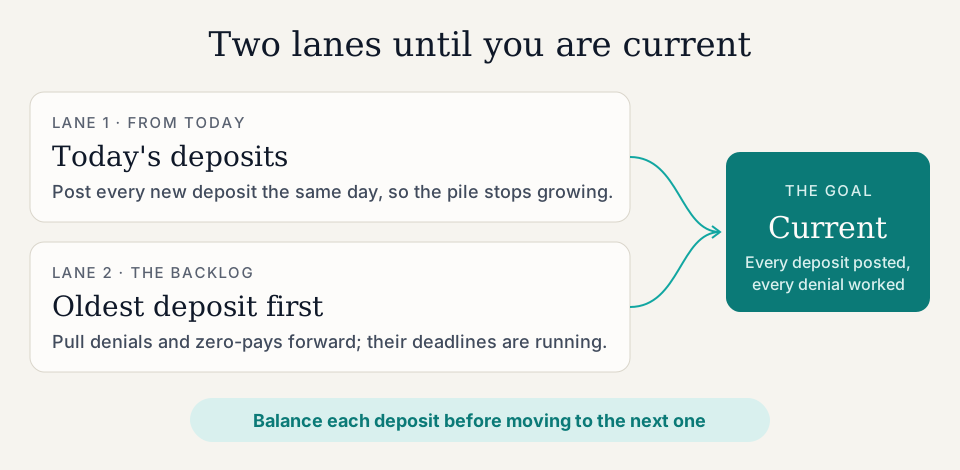
The short answer: catch up on a dental posting backlog in two lanes. From today, post every new insurance deposit the same day, so the pile stops growing. In a second lane, work the backlog oldest deposit first, pulling denials and zero-paid claims to the front because their appeal and filing deadlines are still running. Match each deposit to its EOBs by trace number, post line by line, and balance the deposit before you open the next one.
Posting backlogs rarely start with a decision. A coordinator leaves, a payer moves its EOBs behind a new portal, a busy month pushes posting to Friday and then to next week. In my practice in Glendora, two full-time people work on insurance administration, and I have seen how quickly a few skipped days become a month. The way out is the same in every office, and it is mostly about order.
Step 1: stop the backlog from growing
Before touching anything old, split the work. Every deposit that lands from today goes into the current lane and is posted the same day, using the routine in dental insurance payment posting. Everything older goes into the backlog lane. If the same people do both, the current lane comes first every morning. Otherwise you will finish the backlog only to find a new one behind it.
Step 2: size the backlog
You cannot plan what you have not counted. Spend an hour on these five numbers before posting a single line.
| Count | Where to find it | Why it matters |
|---|---|---|
| Unposted insurance deposits | Bank statements against the deposit report in your practice management system | Tells you how much money arrived with no explanation posted |
| Open insurance claims by age | The insurance aging report | Includes claims paid but never posted, so it overstates what is truly unpaid |
| Payers with no ERA | Your clearinghouse ERA enrollment list | Every one of these is a portal download before posting can start |
| Denials and zero-pays not yet worked | EOBs already downloaded, plus any payer letters | These carry deadlines; they go to the front of the line |
| Unapplied credits | Account credits not tied to a procedure | Often a payment posted in a hurry; each needs a home or a refund |
To turn the count into hours, time your team on twenty typical EOBs, including the portal download, and multiply. That number decides whether the backlog can be cleared in protected hours each week or needs outside help.
Step 3: gather the remittances
Posting starts from the bank, not from the claim. For each unposted deposit, find every remittance behind it by its trace number: import the ERAs, download the portal EOBs and pull the paper ones. A single EFT often pays several EOBs, and a missing one is the usual reason a deposit will not balance.ERA vs. EOB vs. EFT explains how the trace number ties the three together.
Step 4: triage, then post oldest first
- Denials and zero-pays first. A denied line that sits unposted looks like a payment that has not arrived yet. Post the $0 with its reason, and put it on the follow-up list while the appeal window is open.
- Then the oldest deposits. Working forward in date order keeps takebacks and corrected claims in sequence, and it is how the bank statement is organized.
- Post line by line, never as a lump sum. A catch-up is when lump-sum shortcuts are most tempting and most costly, because they hide underpayments and downgrades for good.
- Balance each deposit before the next. The posted total must equal the deposit. If it does not, the difference is a missing EOB, a takeback or interest. How to reconcile insurance deposits walks through each case.
Step 5: work what posting uncovers
A backlog hides more than unposted money. Expect to find denials nobody appealed, allowed amounts below your contracted fee, payer takebacks of earlier overpayments, and credits that should be refunds. Keep a findings list with an owner and a date for each line, and use EOB scrubbing to catch the underpayments. The codes behind each finding are in dental claim adjustment codes.
Step 6: fix patient balances before statements go out
Until the insurance payment is posted, the patient balance is wrong. Hold statements for any account with unposted insurance, send the rest as usual, and release the held ones as each account is posted. It is slower than one big statement run, and it avoids the calls that come from billing patients for what the plan already paid.
Resist the urge to clean the ledger with blanket write-offs. Adjusting off patient portions in bulk, without telling the plan, drifts into one of the practices treated as overbilling. Every adjustment needs a reason you can name.
Step 7: watch two numbers so it does not come back
- Days from deposit to posting. One business day or less.
- Unposted deposits at the end of the day. Zero.
If either number drifts for a week, the backlog is starting again. The full set of revenue cycle measures is indental revenue cycle management, and California offices should check the state's filing and payment deadlines against anything old.
When to get help
If the count in step 2 is more than your team can clear in a month of protected hours, bring in help. A temporary biller or an outsourced billing company can do it, usually for an hourly, per-claim or percentage fee. We built a free option for offices in our startup cohort: our team onboards your office in person, retrieves the missing EOBs, posts every payment and reconciles the deposits until you are current. Then Sai, our AI agent, keeps you there. See how the free dental billing backlog cleanup works.
Sources
- American Dental Association, Principles of Ethics and Code of Professional Conduct, advisory opinion 5.B.1 on waiving copayments.
- California Code of Regulations, title 28, section 1300.71, on the shortest claim filing deadline a plan may set.
Common questions
How do I catch up on a dental insurance posting backlog?
Run two lanes. From today, post every new insurance deposit the same day so the backlog stops growing. In a second lane, work the backlog oldest deposit first, pulling denials and zero-paid claims forward because their appeal and filing deadlines are still running. Match each deposit to its EOBs or ERAs by trace number, post line by line, and balance the deposit before moving to the next one.
How long does it take to clear a dental posting backlog?
It depends on how many EOB lines are waiting and how many of them have to be fetched from payer portals first. Estimate it from your own numbers: count the unposted deposits, time your team posting twenty typical EOBs including the download, and multiply. Offices that only work the backlog in spare minutes rarely finish, so give it protected hours or outside help.
Should we send patient statements while the backlog is open?
Not for accounts with unposted insurance payments. Their balances are wrong until the EOB is posted, and a statement would either overcharge the patient or leave money uncollected. Hold statements for those accounts, keep sending the rest, and release the held ones as each account is posted.
Can we write off old insurance balances to clean up the ledger?
Not as a blanket fix. A balance should only be adjusted off for a reason you can name, such as a contractual write-off on the EOB or a claim that is truly past every appeal deadline. Writing off patient portions in bulk, without telling the plan, can amount to waiving copays, which payers and the ADA treat as overbilling.
What if the timely filing deadline has already passed on some claims?
Find out before you write anything off. If the claim was sent on time and rejected or lost, a clearinghouse acceptance report or a portal screenshot is usually enough proof of timely filing for an appeal. If it was never sent, the office generally absorbs it under an in-network contract and cannot bill the patient. California also limits how short a filing deadline a plan may set.
Who can help a dental office catch up on posting?
A temporary biller, an outsourced billing company, or a free option: Amalgamate Technologies clears the backlog for offices in its startup cohort. Its team onboards the office in person, retrieves the missing EOBs, posts the payments and reconciles the deposits, then its AI agent, Sai for Dentists, keeps the office current.