
How to reconcile dental insurance deposits with your practice management system
The three-way match between bank deposit, remittance and posting, a worked bulk EFT with a takeback, the daily routine, and the six reasons the numbers do not agree.
By Dr. Salem Sayegh, general dentist, Glendora, California ·
The short answer: reconciling dental insurance deposits is a three-way match. The bank deposit, the remittance that explains it (EOB or ERA) and the payments posted in your practice management system must all equal each other. Match the deposit to its remittances by trace number, account for any provider-level adjustments such as takebacks or interest, then confirm the posted total equals the deposit. Do it every day.
Reconciliation is the step that proves every earlier step was done right. It is also the one most often skipped, because it happens last and nothing forces it. In my practice in Glendora, the moment that tells me reconciliation has slipped is always the same: a deposit sits in the bank, and nobody can say which patients it pays.
The three-way match
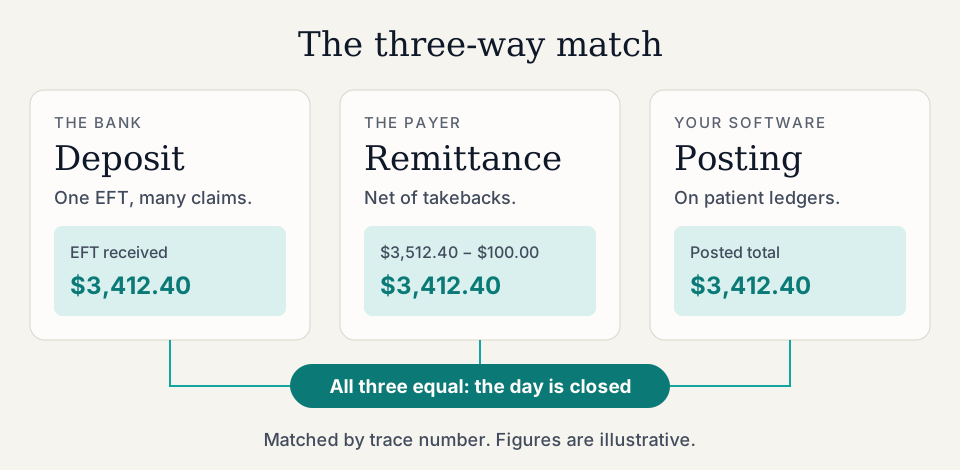
- The deposit is what the bank received, usually an ACH EFT that pays many claims at once.
- The remittance is the payer’s explanation: an ERA (the 835 file) or an EOB from the portal or the mail.
- The posting is what your office entered on each patient’s ledger.
The trace number links them: it is in the ERA’s TRN segment, in the ACH addenda record of the deposit, and on the EOB as the check or EFT number. ERA vs. EOB vs. EFT explains each record in detail.
A worked example: one bulk EFT
A single EFT arrives for $3,412.40. In the payer portal, three EOBs carry the same trace number. Here is how they reconcile, with illustrative figures.
| EOB 1: three patients | $1,284.00 |
|---|---|
| EOB 2: two patients | $968.40 |
| EOB 3: four patients | $1,260.00 |
| Sum of claim payments | $3,512.40 |
| Provider-level adjustment: recovery of an earlier overpayment | −$100.00 |
| Net payment on the remittance | $3,412.40 |
| Bank deposit (EFT) | $3,412.40 |
Without the $100 recovery, the three EOBs add up to $3,512.40, and the deposit looks $100 short. That difference is where offices go wrong in both directions: they write off $100 from some patient to make the day balance, or they leave the deposit unreconciled. The right move is to post the recovery against the original overpaid claim, then confirm the payer was entitled to take it back. California offices should know the 365-day limit on overpayment requests.
The daily reconciliation routine
- List the day’s insurance deposits from the bank, with each trace number. If your online banking cuts off the addenda, ask the bank how to see it in full.
- Match each deposit to its remittances. Find every ERA or EOB with the same trace number. For portal-only payers this means signing in and searching.
- Account for provider-level adjustments. On an ERA these are in the PLB segment: overpayment recoveries, interest, forwarding balances. On a paper EOB they are usually a line at the bottom.
- Confirm the postings. The total posted in the practice management system against those remittances must equal the net payment.
- Investigate every difference before closing the day. A difference you carry forward becomes two differences tomorrow.
- Keep an exceptions list: deposits without remittances, remittances without deposits, and open takebacks, each with an owner.
Six reasons the numbers do not match
| Break | What you see | What it usually is |
|---|---|---|
| A missing EOB | Posted total is short of the deposit | One of the statements behind a bulk EFT is still in the portal. Find it by trace number. |
| A takeback | Remittance claim total is higher than the deposit | The payer recovered an earlier overpayment. Post the recovery against the original claim, then check whether it was owed. |
| Interest | Deposit is slightly higher than the claims | A late-payment interest amount on the remittance. Record it as interest, not as a patient payment. |
| A virtual card | No ACH deposit at all, or a card settlement net of fees | The payment came as a card number. Post the full amount, and book the merchant fee as an expense. |
| A duplicate posting | Posted total is higher than the deposit | The ERA auto-posted and the paper EOB was keyed too. Reverse one. |
| A deposit with no remittance | Money in the bank nobody can explain | Often a new payer or a plan that only offers portal EOBs. Do not post it until you have the statement. |
Monthly close
Daily reconciliation keeps the ledgers right. The monthly close ties the practice management system to the books. Compare the month’s deposit report from your practice management system with the bank statement and with your accounting software. The three should agree, apart from items you can name: deposits in transit, card settlements still pending, and open exceptions. If the gap is a number you cannot explain, go back to the daily exceptions list. It is almost always there.
Why this is hard to keep up by hand
None of it is complicated. It is just constant. Every bulk EFT means hunting for every statement behind it across several portals, adding them up and checking the postings. Every takeback means finding the original claim. It is the work that slips first when the office is busy, and the cost of letting it slip arrives weeks later, when a patient disputes a balance nobody can explain. If months of deposits are already unmatched, start with ourfree dental billing backlog cleanup and reconcile daily from there.
Where Sai for Dentists fits
Reconciliation is one of the three jobs Sai for Dentists was built for, along with pulling EOBs from payer portals and posting them. With read access to the bank account, Sai matches each insurance deposit to its remittances by trace number, accounts for takebacks and interest, confirms the postings in your practice management system add up, and puts every difference on an exceptions list for your team. Read security and HIPAA for how practice and bank data are protected, and dental insurance payment posting for the step that comes before.
Sources
- 45 CFR 162.1602, the HIPAA standards for health care EFT and electronic remittance advice, including the reassociation trace number.
- X12 provider adjustment reason codes, used in the PLB segment of the 835.
- CMS, HIPAA Administrative Simplification guidance on EFT and virtual card payments.
Common questions
What is bank reconciliation in a dental office?
It is confirming that the insurance and patient payments posted in the practice management system match the money that actually arrived in the bank. For insurance, that is a three-way match: the bank deposit, the remittance that explains it (the EOB or ERA), and the payments posted to patient ledgers. When all three agree, the books are right.
How often should a dental office reconcile insurance deposits?
Daily. Each day’s deposits should be matched to their remittances and postings before the day closes. A monthly reconciliation still matters for the books, but by then a missing EOB or a takeback is weeks old and much harder to trace.
Why does my insurance deposit not match the EOB?
The usual reasons: one deposit pays several EOBs and not all of them have been found; the payer took back an earlier overpayment from this payment; the deposit includes interest; or the payment came as a virtual card that settles separately and net of a merchant fee. Add up every remittance under the same trace number, then look for provider-level adjustments.
What is a PLB adjustment on a dental ERA?
PLB is the provider-level adjustment segment of the 835 ERA. It records money added to or taken from the whole payment rather than any single claim, such as recovering an earlier overpayment or paying interest. It is the most common reason an ERA’s claim totals do not equal the deposit, and it often gets overlooked because it is not attached to a patient.
How do you find the trace number on a dental insurance deposit?
On an ERA it is in the TRN segment. On an EOB it usually appears as the check or EFT number. In the bank it is in the ACH addenda record, which many online banking screens cut short. If you cannot see the full addenda, ask your bank how to view or export it, since the trace number is what ties the deposit to its remittance.
Can bank reconciliation for a dental office be automated?
Largely, yes. Software can read the deposits, match each one by trace number to its remittance, confirm the postings in the practice management system add up, and flag anything that does not, such as a missing EOB, a takeback or an unexplained deposit. A person still resolves the exceptions.