
What outsourced dental billing costs in 2026, and what you get for it
The three ways dental billing companies charge, the published price ranges for each, what is usually left out of the quote, and the questions to ask before you sign.
By Dr. Salem Sayegh, general dentist, Glendora, California ·
The short answer: dental billing companies charge in one of three ways. Published 2026 price guides quote a percentage of collections from about 2% to 10%, a flat monthly fee of roughly $1,250 to $1,900 for a smaller office, or about $4 to $12 per claim. What you pay depends less on the headline rate than on what the rate is applied to and which tasks are left out.
I run a general practice in Glendora, California, and two people on my team spend their days on insurance administration. Every dentist in that position has wondered whether to hand the work to a billing company. This is the comparison I would want before taking a sales call.
The three pricing models
| Model | Published range | What to watch |
|---|---|---|
| Percentage of collections | About 2% to 10%, lower at higher volume | The fee rises with your collections even when the workload does not. |
| Flat monthly fee | About $1,250 to $1,900 for smaller offices | Check what volume it covers and what happens above it. |
| Per claim | About $4 to $12 a claim | Ask whether resubmissions and appeals count as new claims. |
These are ranges that billing companies publish about their own market, so treat them as a starting point and get written quotes.
What a percentage costs in dollars
A point and a half sounds small until it is multiplied by a year of collections. Take an office collecting $60,000 a month from insurance.
| Insurance collections per month | $60,000 |
|---|---|
| Fee at 3.5% of collections | $2,100 / month |
| Fee at 5% of collections | $3,000 / month |
| Difference over a year | $10,800 |
Note what the percentage is tied to. If the practice adds a hygienist and collections rise by a fifth, the fee rises by a fifth too. That is the trade in this model: the company is paid more when you collect more, whether or not it did more work.
A monthly minimum changes the rate
Many contracts set a minimum fee and apply the percentage only above a collections threshold. For a smaller office the minimum is the real price, and it works out to a higher rate than the one advertised.
| Insurance collections per month | $30,000 |
|---|---|
| Monthly minimum fee | $1,400 |
| Effective rate ($1,400 ÷ $30,000) | 4.7% |
What is usually included, and what is not
| Task | Typical | Ask |
|---|---|---|
| Claim submission | Usually included | Who attaches X-rays, narratives and perio charting? |
| Insurance payment posting | Usually included | Line by line, or as a lump sum on the claim? |
| Unpaid claim follow-up | Usually included | How old does a claim get before someone calls? |
| Denial appeals | Usually included | Is there a limit on appeals per claim? |
| Deposit reconciliation | Varies | Do they match postings to your bank deposits, or stop at posting? |
| Insurance verification | Often extra | Per patient, or per month? |
| Patient statements | Often extra | Who answers the patient’s call about the balance? |
| Credentialing | Often extra | One-time fee per payer? |
Questions to ask before you sign
- What is the percentage applied to? Insurance payments only, or every dollar the office collects.
- Is there a monthly minimum, or a cap? A slow month can cost the same as a busy one.
- Does the percentage apply to old balances collected after you take over?
- Are there setup, clearinghouse or software fees on top?
- Who will work my account, and how many offices do they carry?
- How do you get into my systems? Remote access to the practice management software and logins to every payer portal are the norm. Ask how credentials are stored.
- Will you sign a business associate agreement? HIPAA requires one.
- Do you reconcile to the bank? Posting a payment and confirming the deposit arrived are different jobs.
- What reports will I see, and how often? At minimum: claims sent, payments posted, and the aging report by 30, 60 and 90 days.
- What does leaving look like? Notice period, and who finishes the claims already in flight.
Outsourcing, in-house, or software
Outsourcing moves the work to someone else's staff. It does not remove the work. Portals still get logged in to, statements still get downloaded and keyed in, by people you do not see. The alternatives are keeping it in-house, where you carry the salary and the turnover risk, or using software to do the repetitive part.
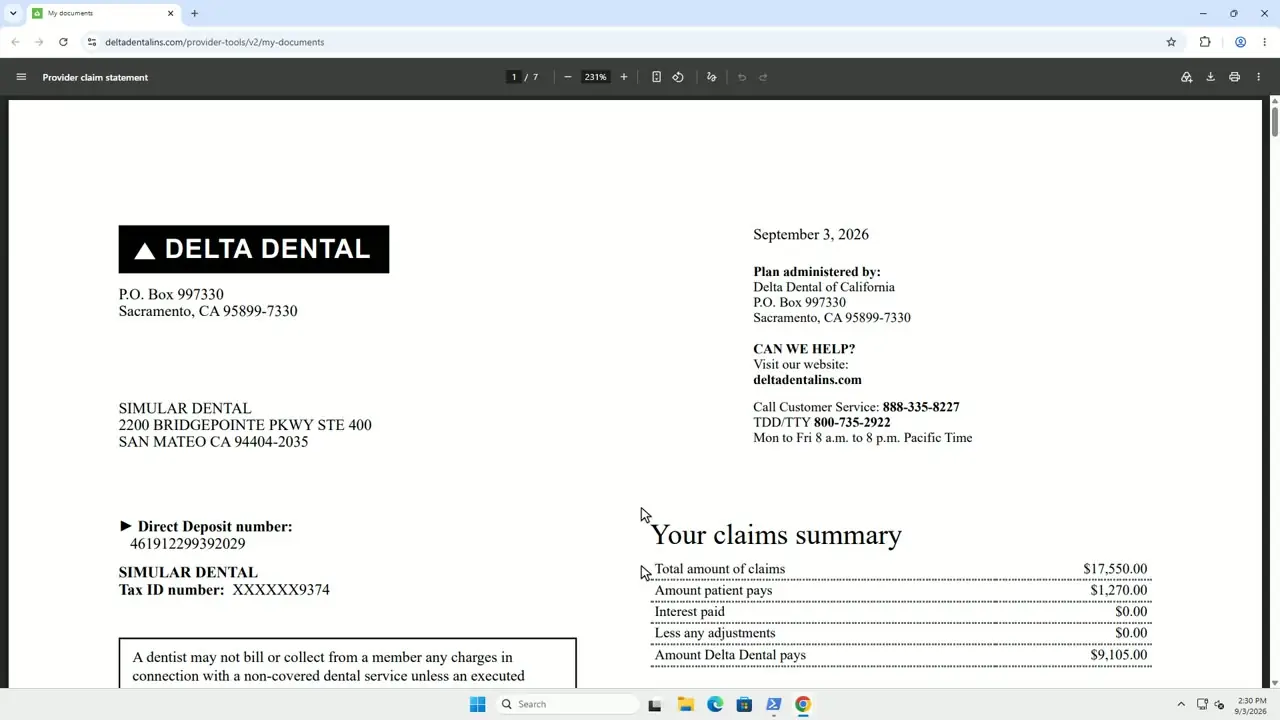
That third route is what we are building. Sai for Dentists is an AI agent that works on a dedicated computer in the office. It retrieves EOBs from payer portals, posts the payments and write-offs in your practice management software and reconciles them against bank deposits. It is priced at a fixed amount, not a percentage of collections, and it is free for offices in the startup cohort.
It is not a full replacement for a billing company today. Sai does not submit claims or argue appeals. An office can run it beside an in-house coordinator or beside the billing company it already uses. The longer comparison is in AI for dental billing: what it can do today, and Southern California offices can read how the cohort works.
Sources
- Dental ClaimSupport, factors in the cost of dental billing services and its guide for offices collecting under $40,000 a month.
- Helpware, dental billing outsourcing pricing models.
- 45 CFR 164.502(e) and 164.504(e), HIPAA business associate requirements.
Common questions
How much does it cost to outsource dental billing?
Price guides published by dental billing companies in 2026 describe three models: a percentage of collections, quoted anywhere from about 2% to 10%; a flat monthly fee, roughly $1,250 to $1,900 for an office collecting under $40,000 a month from insurance; and a per-claim fee of about $4 to $12. The percentage usually falls as collections rise.
Is the percentage charged on insurance collections or on everything the office collects?
It depends on the contract, and it changes the bill a great deal. Some companies charge only on insurance payments they worked. Others charge on total collections, including what patients pay at the front desk. Ask for the base in writing before you compare quotes.
What does an outsourced dental billing company do?
Commonly: submit claims, post insurance payments, work the unpaid-claims aging report and appeal denials. Insurance verification, patient statements and credentialing are often separate services with their own fees.
Is outsourced dental billing cheaper than doing it in-house?
It can be for a small office that would otherwise hire a full-time insurance coordinator, because the fee is usually less than a salary with benefits. A larger office paying a percentage of collections can end up paying more than an employee would cost. Run both numbers on your own collections.
Does a dental billing company need a HIPAA business associate agreement?
Yes. A billing company handles protected health information on the practice’s behalf, which makes it a business associate under HIPAA. The practice must have a signed business associate agreement with it before giving it access to patient records.
What does Sai for Dentists cost compared with a billing company?
Sai is priced at a fixed amount rather than a percentage of collections, and offices in the Southern California startup cohort use it free as design partners. It covers EOB retrieval, payment posting and bank reconciliation, so it can replace that part of the work or run alongside a billing company that handles claims and appeals.