
Dental insurance verification form: a free printable template, and what to ask the payer
A one-page form covering coverage, maximums, frequencies, waiting periods and clauses, what each section is for, when and how to verify, and the denials it prevents.
By Dr. Salem Sayegh, general dentist, Glendora, California ·
The short answer: a dental insurance verification form records, before the visit, that the patient’s coverage is active and what the plan will pay: maximums and deductibles, coverage by category, frequencies, waiting periods and clauses such as downgrades, plus who confirmed it and when. Our free form covers all of it on one page. Open the printable form, then print it or save it as a PDF.
Most denials that reach the front desk were decided before the patient sat down: coverage that ended last month, a cleaning one month too soon, a maximum used up at another office. A verification form will not catch every one, but a consistent form, filled in the same way for every patient, catches most of them and leaves a record if the payer later says something different. We use the same sections in my practice in Glendora.
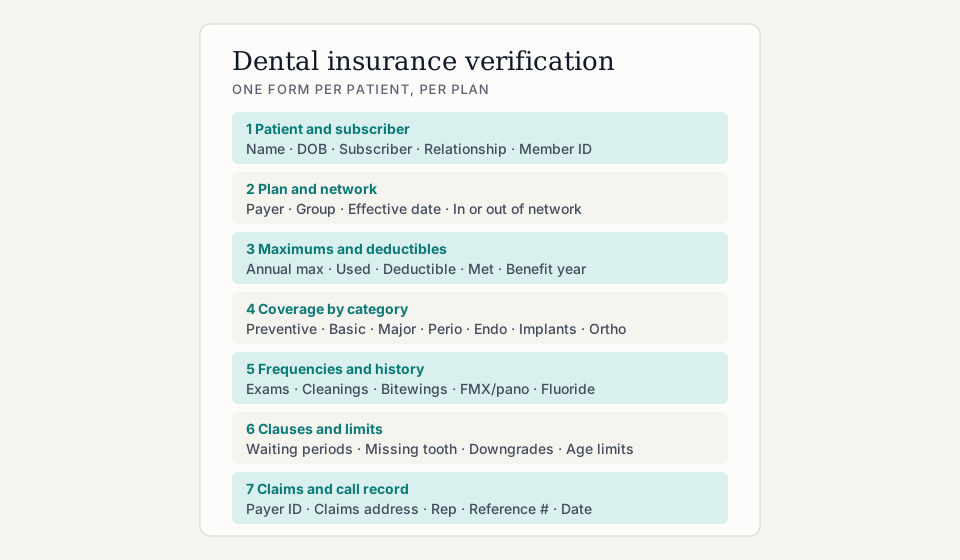
What each section asks, and why
| Section | What to record | Why it matters |
|---|---|---|
| 1. Patient and subscriber | Name, date of birth, subscriber, relationship, member ID, employer | A wrong ID or date of birth gets the claim rejected before anyone reads it |
| 2. Plan and network | Payer, group, plan type, effective and end dates, network status, fee schedule | Sets which fee schedule applies and whether there is a contractual write-off |
| 3. Maximums and deductibles | Benefit year, annual maximum and amount used, deductible and amount met | A maximum already used up turns a covered crown into a patient bill |
| 4. Coverage by category | Percentage and waiting period for preventive, basic, perio, endo, surgery, major, implants, ortho | The basis of every estimate you give the patient |
| 5. Frequencies and history | How often exams, cleanings, perio maintenance, x-rays, fluoride and sealants are covered, how the plan counts, last dates paid | Frequency denials are among the most common, and history from another office counts |
| 6. Clauses and limits | Missing tooth clause, alternate benefit on posterior composites, predetermination, other insurance | Downgrades and missing-tooth exclusions surprise patients unless they are told first |
| 7. Claims and call record | Payer ID, claims address, filing limit, how verified, representative, reference number, date | Your evidence if the payer later denies what it quoted |
When to verify
- A few business days before every appointment. Early enough to reach the patient if coverage has ended or a plan has changed.
- Again for anyone who mentions a new job, a marriage or a new plan. Coverage follows the employer.
- Before major treatment. Confirm the remaining maximum, the waiting period and whether the plan wants a predetermination.
How to verify: portal, phone or electronic eligibility
There are three routes, and most offices use all three. The payer portal is usually fastest and shows history. A call to provider services answers what the portal does not, and gives you a representative’s name and a reference number for the form. An electronic eligibility check (the X12 270 request and 271 response, often run through your clearinghouse or practice management system) confirms active coverage in seconds, though for dental it often leaves out frequencies, history and clauses.
Whatever the route, write down how you verified, who you spoke to and when. Payers state that benefits quoted are not a guarantee of payment, so the call record is what you cite in an appeal.
The denials it prevents
Each of these shows up later as an adjustment code on the EOB.Dental claim adjustment codes explains every one.
- Coverage terminated (reason code 27): caught by checking the end date.
- Frequency limits (code 151): caught by recording the last dates paid and how the plan counts.
- Maximum reached (code 119): caught by recording what is left of the annual maximum.
- Another payer may be primary (code 22): caught by asking about other insurance.
Verification is step 2 of the eleven in dental revenue cycle management. Several AI vendors now automate it, listed in AI agents for dental offices. Sai for Dentists does not verify insurance yet; it handles the other end of the cycle.
The other end: posting what comes back
Verification decides how clean the claim is going out. Posting decides whether the money that comes back is recorded correctly, and that is where offices fall behind. If EOBs are piling up faster than your team can post them, our startup cohort clears the backlog free: our team onboards your office in person, posts every payment and reconciles the deposits, then Sai keeps you current. See thefree dental billing backlog cleanup.
Sources
- X12 claim adjustment reason codes.
- American Dental Association, CDT: Code on Dental Procedures and Nomenclature.
Common questions
What should a dental insurance verification form include?
Seven groups of information: patient and subscriber details; the plan, group and network status; the annual maximum and deductible with what is used; coverage percentages and waiting periods by category; frequencies and the dates of past services; clauses such as missing tooth, alternate benefit and predetermination; and the claims details plus a record of who verified it, how and when.
When should a dental office verify insurance?
A few business days before each appointment, so there is time to fix a problem before the patient arrives, and again for any patient who says their job or plan has changed. A once-a-year check misses terminated coverage and frequencies used at another office.
What is the difference between eligibility and a full breakdown of benefits?
Eligibility confirms that coverage is active on the date of service. A full breakdown adds what the plan will pay: maximums, deductibles, percentages, frequencies, waiting periods and clauses. An electronic eligibility response often answers the first and only part of the second, so offices still use the payer portal or a phone call for the rest.
Does verifying insurance guarantee the claim will be paid?
No. Payers state that benefits quoted are not a guarantee of payment, because the claim is decided on the plan rules and the patient’s history when it arrives. Verification lowers the risk and gives you a dated record, including the representative’s name and a reference number, to cite in an appeal.
Which denials does insurance verification prevent?
Mostly the avoidable ones: coverage terminated before the visit, a service over its frequency limit, a maximum already used up, a waiting period not yet met, and claims sent to the wrong plan first when a patient has two. Dental claim adjustment codes 27, 151, 119 and 22 are the usual signs.
Can AI verify dental insurance?
Several vendors offer AI agents that check eligibility and benefits in payer portals and by phone. Sai for Dentists does not verify insurance yet; it retrieves EOBs, posts payments and reconciles deposits after the claim is paid. Our guide to AI agents for dental offices lists vendors by the job they do.