
EOB scrubbing: how to audit dental EOBs for underpayments, downgrades and denials
Why short payments look like ordinary write-offs, the eight checks to run on every EOB line, a worked underpaid crown, and a three-pass method that makes checking every line practical.
By Dr. Salem Sayegh, general dentist, Glendora, California ·
The short answer: EOB scrubbing is auditing every line of an explanation of benefits after the claim is paid. For each procedure you check three things: the allowed amount matches your contracted fee, the plan’s rules were applied correctly, and the patient’s share adds up. Claim scrubbing catches errors before a claim goes out. EOB scrubbing catches the payer’s errors when the money comes back, before a short payment gets written off as if it were normal.
Every dental office scrubs claims before sending them. Far fewer scrub the EOB that comes back, and that is where money leaks. In my practice in Glendora, four problems account for most of what we find: downgrades, frequency denials, documentation denials and allowed amounts below our contracted fee. None of them look like errors on the EOB. They look like ordinary write-offs.
Why underpayments hide in plain sight
A denial is obvious: the line pays zero. An underpayment is not. When a payer allows less than your contract says, the EOB still shows a normal contractual write-off under code CO-45, just a bigger one. Whoever posts it enters the payment, takes the write-off and moves on. Nothing on the screen is wrong except the number, and you can only see that against the contract.
Here is what that looks like on one crown, with illustrative numbers.
| D2740 crown, submitted fee | $1,400.00 |
|---|---|
| Contracted fee in the office’s PPO agreement | $980.00 |
| Allowed amount on the EOB | $905.00 |
| Plan paid at 50% | $452.50 |
| Patient portion on the EOB | $452.50 |
| Write-off on the EOB (CO-45) | $495.00 |
The EOB adds up: $452.50 from the plan plus $452.50 from the patient is the $905 allowed, and $905 plus the $495 write-off is the $1,400 fee. It passes every arithmetic check. But the contract says $980, so the allowed amount is $75 short. The plan owes the office $37.50 more and the patient owes $37.50 more, and the write-off is $75 too large. Posted as-is, that $75 is gone. Repeat it across every crown from that payer for a year and it is real money.
What to check on every EOB line
| Check | The question | If it fails |
|---|---|---|
| Allowed amount | Does it equal the contracted fee for this plan, this code and this date? | Underpayment: request reprocessing with your contract page |
| Procedure code | Did the payer process the code you submitted, or substitute another? | Downgrade: bill the patient the difference if your contract allows, or appeal |
| Frequency | Is the denial right? Check the patient’s actual history and how the plan counts | Wrong count: appeal with dates; right count: bill the patient if they were told |
| Documentation | Was the denial for a missing x-ray, perio chart or narrative? | Send the attachment; most of these get paid |
| Bundling | Was a separately billable procedure folded into another? | Appeal with documentation, or write off under the contract |
| Patient share | Do deductible, coinsurance and plan payment add up to the allowed amount? | Math error: call the payer before posting |
| Coordination of benefits | Is this plan really primary? Was the other plan’s payment counted? | Rebill in the right order |
| Takebacks | Is part of this payment recovering an earlier claim? | Post the recovery to the original claim, then check it was owed |
The codes behind each finding, CO-45, CO-97, 119, 151, CO-16 and the rest, are explained in dental claim adjustment codes.
The four findings that matter most
1. Allowed amount below the contracted fee
Causes include a fee schedule the payer never updated after renegotiation, the wrong network’s schedule for a plan with more than one network, or a schedule for the wrong office location or provider. Keep your current fee schedule for every contracted plan where whoever posts can see it. Send underpayments back with the page of the contract that shows the fee.
2. Downgrades under an alternate benefit clause
The most common in my office: a posterior composite (D2391 or D2392) paid as if it were an amalgam (D2140 or D2150), because the plan covers the least expensive alternative. The plan is not wrong to apply its clause. The loss comes when the office writes off the difference instead of billing it. Under many PPO contracts the patient owes the gap up to your contracted fee for the composite. Check your contract, and tell patients about the clause before treatment so the bill is not a surprise.
3. Frequency denials
Prophies, bitewings, full-mouth series and fluoride denied as too soon. Plans count differently: per calendar year, per benefit year, or per rolling twelve months, and some count from the date of the last paid service at any office. Before accepting a frequency denial, check the dates. Payers do get them wrong, and the appeal is a one-line letter with the correct history.
4. Missing documentation
Crowns, buildups, scaling and root planing and some extractions are denied or pended for missing radiographs, perio charting or a narrative. These are the most recoverable denials there are. The mistake is not the denial itself but letting it sit until the filing deadline passes.
A three-step method that scales
Checking every line by hand is why most offices don’t do it. The method that makes it practical splits the work into three passes, each catching what the last one could not.
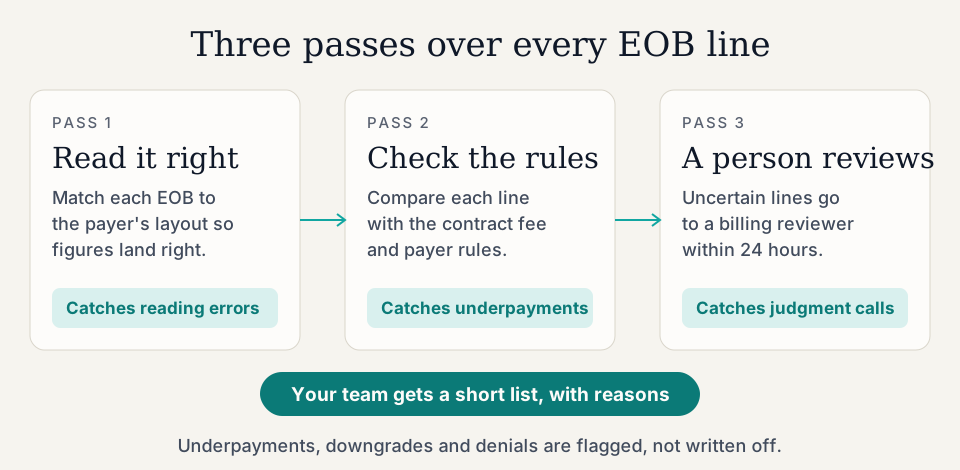
- Read it right. Every payer lays out its EOB differently. The first pass matches each statement to that payer’s known layout, so the allowed amount lands in the allowed field and the right line goes to the right procedure. Most posting errors start as reading errors.
- Check it against the contract and the rules. Each line is compared with the office’s contracted fee schedule for that plan, PPO, premier-network or Medicaid, and with the payer’s own bundling, frequency and alternate-benefit rules. This is where underpayments and wrong denials surface.
- Send the uncertain ones to a person. Anything the first two passes are not confident about goes to a trained billing reviewer, with a turnaround measured in hours, not weeks. The software does the volume, and a person handles the judgment calls.
What to do with each finding
- Underpayment: ask the payer to reprocess at the contracted fee. Most payers have a provider portal form or a provider services line for this. Keep a log by payer, because a pattern is a contract problem worth raising with provider relations.
- Downgrade: bill the patient the difference if your contract allows, or appeal with a narrative if the more expensive treatment was clinically required.
- Wrong frequency denial: appeal with the service dates.
- Documentation denial: send the attachment or narrative and track it to payment.
- True bundle or true non-covered service: write it off or bill the patient, according to your contract and what the patient agreed to.
Where Sai for Dentists fits
Sai for Dentists runs the three passes above as part of posting. It pulls each EOB from the payer portal and reads it against that payer’s layout. It checks every line against your contracted fee schedules and the payer’s rules, and sends anything uncertain to a human billing reviewer. Your team gets a short list of underpayments, downgrades and denials with the reason already attached. Nobody has to find them first. If you want to see how posting itself works, read dental insurance payment posting.
Sources
- American Dental Association, CDT: Code on Dental Procedures and Nomenclature.
- X12 claim adjustment reason codes.
- California offices: payment deadlines, interest and overpayment rules that apply when you dispute a payment.
Common questions
What is EOB scrubbing?
EOB scrubbing is checking every line of an explanation of benefits after the payer has processed a claim. The checks: was each procedure paid at the contracted fee, under the plan’s actual rules, with the patient’s share calculated correctly? Claim scrubbing checks a claim before it goes out. EOB scrubbing checks what came back, so underpayments, downgrades and wrong denials get caught instead of written off.
What is the difference between claim scrubbing and EOB scrubbing?
Claim scrubbing happens before submission. It looks for missing tooth numbers, invalid codes, missing attachments and other errors that would get a claim rejected. EOB scrubbing happens after payment. It compares what the payer paid with your fee schedule, the plan’s rules and what you submitted. A clean claim can still come back underpaid, so a practice needs both.
How do I know if a dental insurance payer underpaid a claim?
Compare the allowed amount on each EOB line with the fee in your contract for that plan and that procedure code. If the allowed amount is lower, the payer may have used the wrong fee schedule, an outdated one, or another network’s schedule. The EOB will usually just show a normal CO-45 write-off, so the only way to see the underpayment is to check the number against the contract.
Can a patient be billed for a dental downgrade?
Often, yes. When a plan pays a posterior composite at the amalgam rate under an alternate benefit clause, many PPO contracts let the office bill the patient the difference between the alternate benefit and the contracted fee for the composite. Contracts and state rules vary, so check yours, and tell patients about the clause before treatment.
How much revenue do dental offices lose to EOB errors?
There is no reliable published figure for dental, and anyone quoting one precisely is guessing. The losses come from four places: underpaid allowed amounts, downgrades written off instead of billed, frequency or documentation denials never appealed, and patient portions never collected. Each is small per line. Over a year they add up, which is why the check has to happen on every line, not on a sample.
Can AI scrub dental EOBs?
Yes, and it is well suited to the job because the checks are the same on every line. A good system reads the EOB accurately for each payer’s layout, checks each line against the office’s contracted fee schedules and the payer’s rules, and sends anything it is not confident about to a human reviewer. People still decide what to appeal.